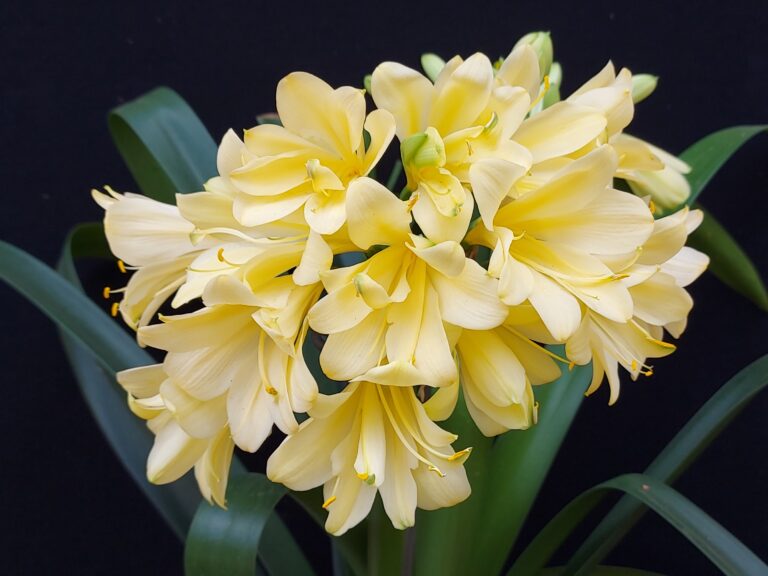
Years ago, when we started in clivias we discussed the idea of breeding for multipetal interspecifics with Rudo Lotter and his dad, it was something we thought could create an interesting and different facet to interspecifics and an avenue that would be worth exploring further. At the time however it was nothing more than an idea and one that would probably be a multi-generational project to achieve the desired results.
What had triggered this discussion was a seedling from Cinderella x Gorgeous Girl that we had acquired from Rudo. Both parents in this cross are split for group 1 yellow and this plant, that we later named Giselle, is a beautiful, flared group 1 yellow interspecific with green tips that has petaloids in a lot of its flowers. Rudo had not initially noticed this when he offered the plant to us and had only liked it for its shape, which he considered the ideal shape for an interspecific, something that our NCC judges obviously agree with as this plant won best on show in 2014 at the NCC interspecific show as well as runner-up best on show at a later show. At the time I offered the plant back to him, but he said that it was a project I could take on as he was not interested in working further with it and personally, he felt that the petaloids ruined what would otherwise be a perfect flower in his eyes.
Cinderella
Gorgeous Girl
I however, already had a plan for this plant and happily brought it home to test a theory I had. A couple of years before this we had acquired a Nakamura group 1 yellow miniata from Bertie Guilaume that also makes petaloids. Originally when we got this plant, I had the idea of breeding our own multipetal yellows using it but crosses with a Solomone multipetal yellow had not resulted in the multipetals I had hoped for. This made me consider that there must be a difference between petaloid multipetals and the “normal” multipetals that have extra rows of petals in the flower. My theory was that if both parents have petaloids then one would possibly be more successful in carrying this trait through to the next generation. So, the next season when the Nakamura yellow flowered it got pollinated with Giselle.
Nakamura petaloid yellow
Giselle - petaloids
From the resulting seeds we grew on ten of which nine made it to flowering size. Out of those nine four were plain yellow interspecifics, three showed some petaloids in the flowers and two produced large almost miniata like flowers that are fully multipetal with up to 3 layers of petals in the flowers. These last two were kept for further breeding and we named them Copelia and Sylphide.
Copelia
Sylphide
The flowers in these two plants have had most of their stamens and even the stigma in some cases converted to petals/petaloids creating a stunning “double” flower but this does mean that they do not produce a lot of pollen however fortunately enough for me to have been able to do sibling crosses with them.
We have subsequently started flowering this next generation of seedlings of Copelia and Sylphide crossed with each other. They are generally small plants with narrow leaves but so far, all the seedlings that have flowered have been fully multipetal, some even better than the two parents. This would indicate that crossing a petaloid multipetal with another petaloid multipetal does seem to produce multipetals in the subsequent generations.
Sylphide-x-Copelia-A.
Sylphide x Copelia C
Sylphide x Copelia-D
Interestingly though, crosses using Giselle pollen onto non-petaloid interspecifics has so far only produced normal interspecifics without extra petals or petaloids.
Where to from here though. For me the next challenge is to bring in different colours, group 1 peach being the most obvious option because of its compatibility with group 1 yellow, crosses with a petaloid peach acquired from Francois van Rooyen are on their way, and we will see but all seedlings were unpigmented so that’s a good start. Crosses have also been made with other miniatas and interspecifics of different colours that showed petaloid/multipetal traits.
I would also like to try and breed back to a more pendulous shape flower to get back to a more typical interspecific shape flower. However, this is where this beautiful hobby of ours teaches us patience, time will show if any of these attempts have been successful.